
Two Sessions a Week: How Brief Strength Training Cuts Mortality and Preserves Independence After 55
Just 30–60 minutes of weekly strength training is tied to a 17% lower all-cause mortality risk — here's what the peer-reviewed evidence says for adults 55+, and how to start safely.
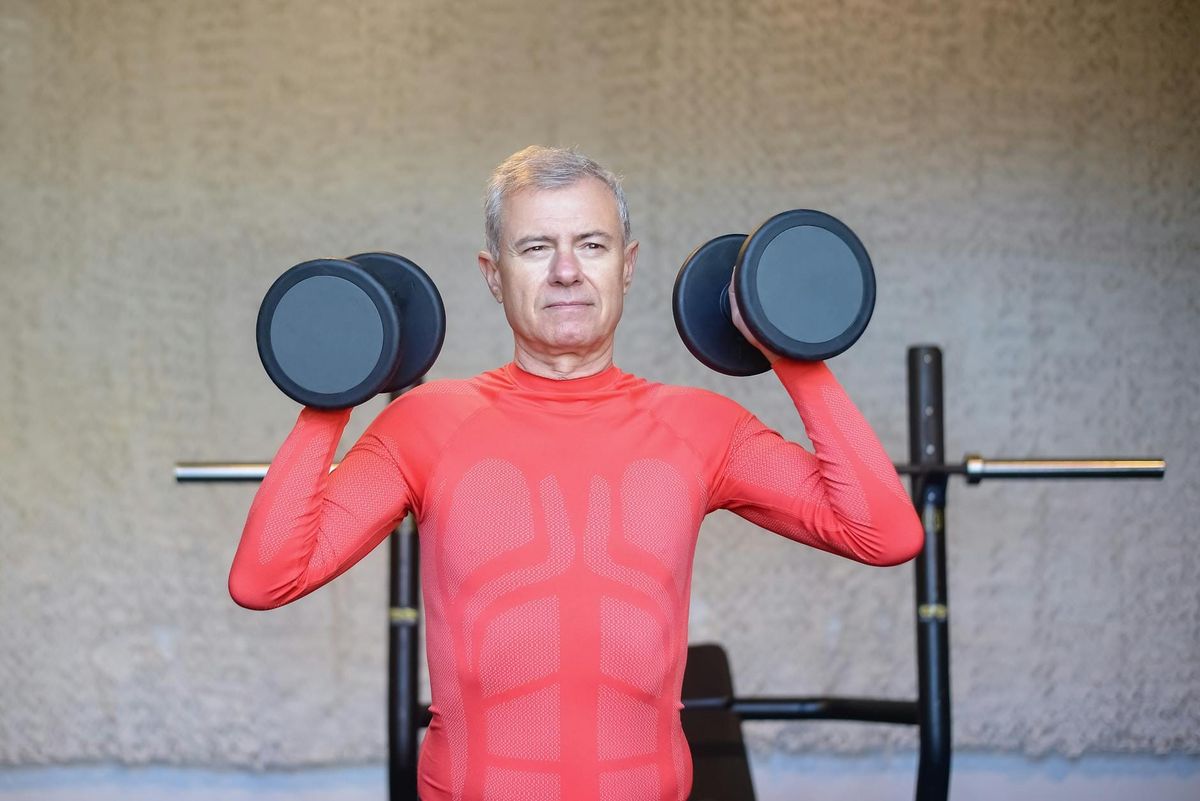
This content is for educational purposes only and is not a substitute for professional medical advice.
Two Sessions a Week Can Add Years to Your Life
Here is a statistic that stopped us in our tracks. A 2022 meta-analysis published in the British Journal of Sports Medicine found that adults who do just 30 to 60 minutes per week of muscle-strengthening activity have a 10–20% lower risk of dying from any cause — including reduced risk of heart disease, cancer, and type 2 diabetes. That is less time than one episode of your favorite show, spread across the entire week, in exchange for years of added life and independence.
If you are 55 or older and you are not yet strength training, this article could be the most important read of your month. We will walk you through what the peer-reviewed evidence actually says, why it matters more after midlife than at any other age, and exactly how to get started safely.
Why Strength Matters More After 55
Starting in our thirties, we begin losing muscle mass at roughly one percent per year. After 60, that loss accelerates to two or three percent annually, and the decline in strength is even faster than the loss of bulk. Doctors call this gradual decline sarcopenia, and it is the single biggest predictor of losing the ability to stand from a chair, walk to the mailbox, or recover from a hospital stay.
Here is the part many older adults are never told: that decline is not inevitable — it is largely reversible. The same muscle that took decades to weaken can be meaningfully rebuilt in eight to twelve weeks of consistent training, even in people in their seventies, eighties, and nineties. For decades, public-health guidance focused on aerobic exercise. Aerobic exercise protects your heart. Strength training protects your autonomy.
The Evidence Review
1. The 30-to-60 Minute Sweet Spot
Momma and colleagues, writing in the British Journal of Sports Medicine in 2022, pooled 16 prospective cohort studies. They found that adults who performed muscle-strengthening activities had a 17% lower risk of all-cause mortality, a 17% lower risk of cardiovascular disease, and a 12% lower risk of cancer. The benefits maxed out at just 30 to 60 minutes per week — doing more did not produce additional mortality reduction.
Momma H, Kawakami R, Honda T, Sawada SS. British Journal of Sports Medicine. 2022;56(13):755-763. DOI: 10.1136/bjsports-2021-105061. PMID: 35228201.
2. Strength Training and All-Cause Mortality
Saeidifard and colleagues published a systematic review and meta-analysis in the European Journal of Preventive Cardiology in 2019. Across 11 studies and approximately 370,000 adults, any engagement in muscle-strengthening activity was associated with a 21% reduction in all-cause mortality. When strength training was combined with regular moderate-to-vigorous aerobic activity, the risk reduction climbed to 40%.
Saeidifard F, Medina-Inojosa JR, West CP, et al. European Journal of Preventive Cardiology. 2019;26(15):1647-1665. DOI: 10.1177/2047487319850718.
3. The Strength-Longevity Link in Two Million People
García-Hermoso and colleagues (2018) pooled data from approximately two million apparently healthy adults in Archives of Physical Medicine and Rehabilitation. They found a consistent, dose-dependent inverse relationship between muscular strength and mortality. The stronger you are, the longer you tend to live — even after adjusting for age, body weight, and cardiovascular fitness.
García-Hermoso A, Cavero-Redondo I, Ramírez-Vélez R, et al. Archives of Physical Medicine and Rehabilitation. 2018;99(10):2100-2113.e5. PMID: 29425700.
4. The Cochrane Review on Daily Function
Liu and Latham reviewed 121 randomized trials including 6,700 people over the age of 60 in a Cochrane systematic review. Twice-weekly progressive resistance training produced a large gain in muscle strength, moderate-to-large improvements in functional tasks like rising from a chair, and a small but statistically significant gain in complex daily activities. Severe adverse events were rare.
Liu CJ, Latham NK. Cochrane Database of Systematic Reviews. 2009;(3):CD002759. DOI: 10.1002/14651858.CD002759.pub2. PMID: 19588334.
5. The NSCA Position Stand for Older Adults
An expert panel led by Dr. Maren Fragala reviewed hundreds of studies for the National Strength and Conditioning Association in 2019. Their conclusion: properly prescribed resistance training in older adults is safe, effective, and produces gains in strength, muscle mass, bone density, balance, and metabolic health. Their prescription: two to three sessions per week, working all major muscle groups, with gradual load progression.
Fragala MS, Cadore EL, Dorgo S, et al. Journal of Strength and Conditioning Research. 2019;33(8):2019-2052. DOI: 10.1519/JSC.0000000000003230. PMID: 31343601.
Five Practical Steps to Get Started
- Get medical clearance first. Especially if you have heart disease, uncontrolled blood pressure, recent surgery, severe osteoporosis, or joint replacements, ask your physician: "Are there any movements I should avoid, and is it safe for me to lift moderate loads?"
- Aim for two 30-minute sessions per week. The Momma meta-analysis found the biggest mortality benefit in the 30–60 minute-per-week range.
- Train all major muscle groups. Each session, include a leg movement (sit-to-stand), a pulling movement (seated band row), a pushing movement (wall or counter push-up), and a core movement (seated march or gentle plank).
- Progress slowly but progress. Each week add a rep, a slightly heavier band, or an extra set. Stop if anything causes sharp or joint pain and consult a physical therapist.
- Consider a qualified trainer for the first 4–6 weeks. YMCAs, senior centers, and Silver Sneakers programs offer small-group classes designed for adults over 55. Look for trainers credentialed by NSCA or ACSM.
The Bottom Line
Two short strength sessions a week, layered on top of your regular walks, is one of the highest-return health investments available to anyone over 55. The evidence is consistent across millions of participants and decades of research. Talk to your doctor, start gently, and remember: progress, not perfection.
Medical Disclaimer: This content is for educational purposes only and is not a substitute for professional medical advice. Always consult your physician or a qualified healthcare provider before beginning a new exercise program.